Physical Address
304 North Cardinal St.
Dorchester Center, MA 02124
Physical Address
304 North Cardinal St.
Dorchester Center, MA 02124

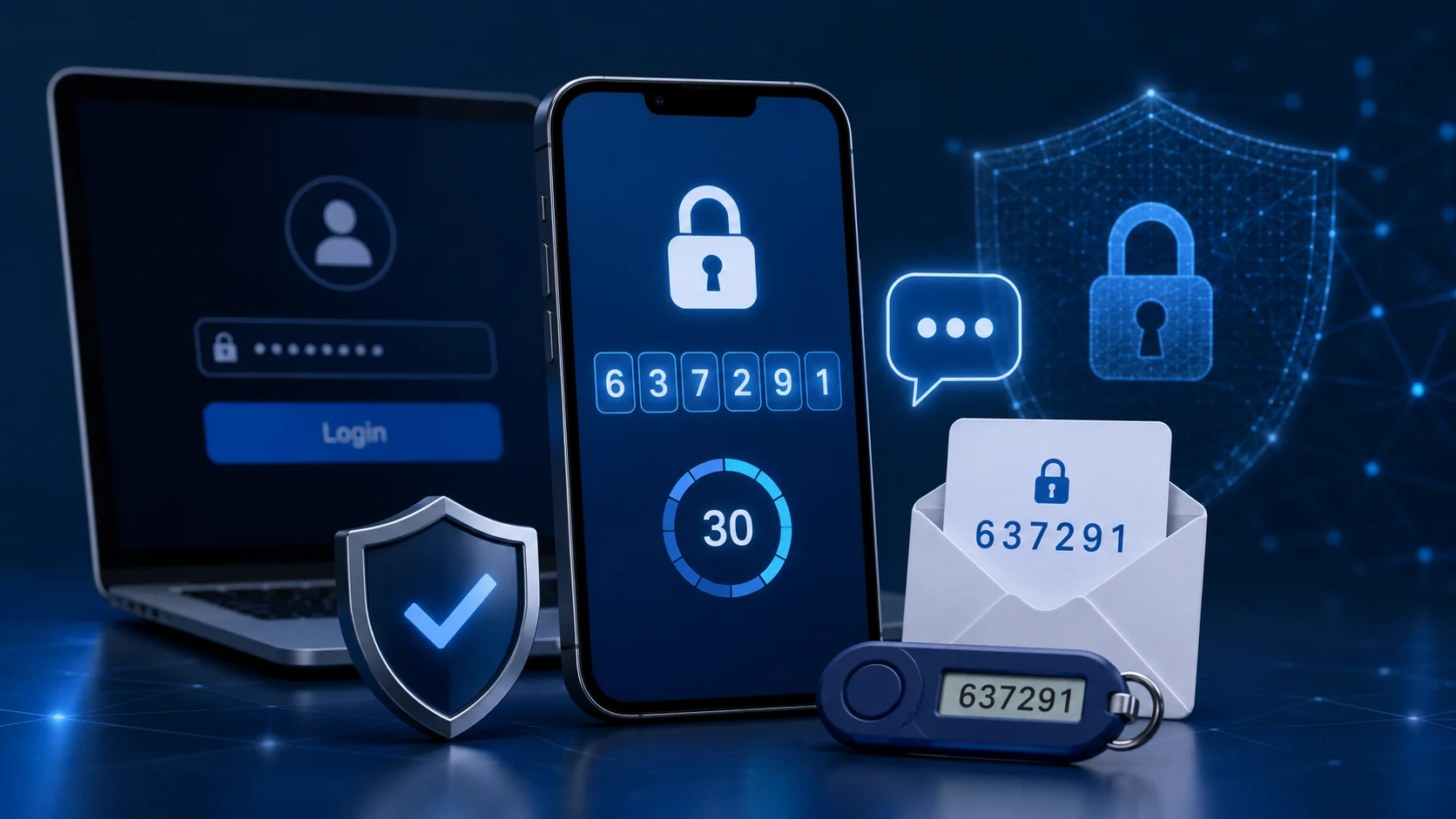
In 2025, $442 billion was stolen worldwide, and most of it started with stolen passwords. OTPs act as the final layer of protection. A phishing attack can steal your password in seconds, and a data breach leaks millions of passwords overnight.
Yet with a one-time password (OTP), even a stolen code is worthless the moment it expires, and that expiry can be as short as 30 seconds. Whether you’re logging into accounts, making online payments, or verifying identity on apps and websites, OTP codes are a common part of our daily online activities.
In this blog post, you’ll learn what is an OTP, the three main types, how each works technically, and why OTPs have become a non-negotiable layer of digital security in 2026.
A one-time password or one-time passcode (OTP) is a widely used form of two-factor authentication (2FA) used to verify the user’s identity per transaction or login session.
It’s a strong, auto-generated, temporary string of numbers or characters that is valid once. Unlike a regular password, an OTP is created fresh every time and stops working after it is used or expires. Many businesses and organizations rely on one-time passwords to reduce cybercrime.
It confirms you have access to a trusted device/app and adds extra security after you enter your password. A one-time password protects against credential theft.
A hacker can steal your password in 3 seconds, but they can’t steal a code that stops existing in 30 seconds until you tell them.
A One-Time Password (OTP) is an essential tool to verify identity, prevent unsafe access or attacks where cybercriminals intercept and try to reuse credentials.
Here are the key properties of every OTP:
Every OTP system relies on a shared secret between your device (or phone number) and the server. When you attempt to log in, both sides run the same mathematical algorithm independently. If their outputs match, you are authenticated. Most OTP systems follow a pattern that includes trigger, generation, delivery, verification, and expiration.
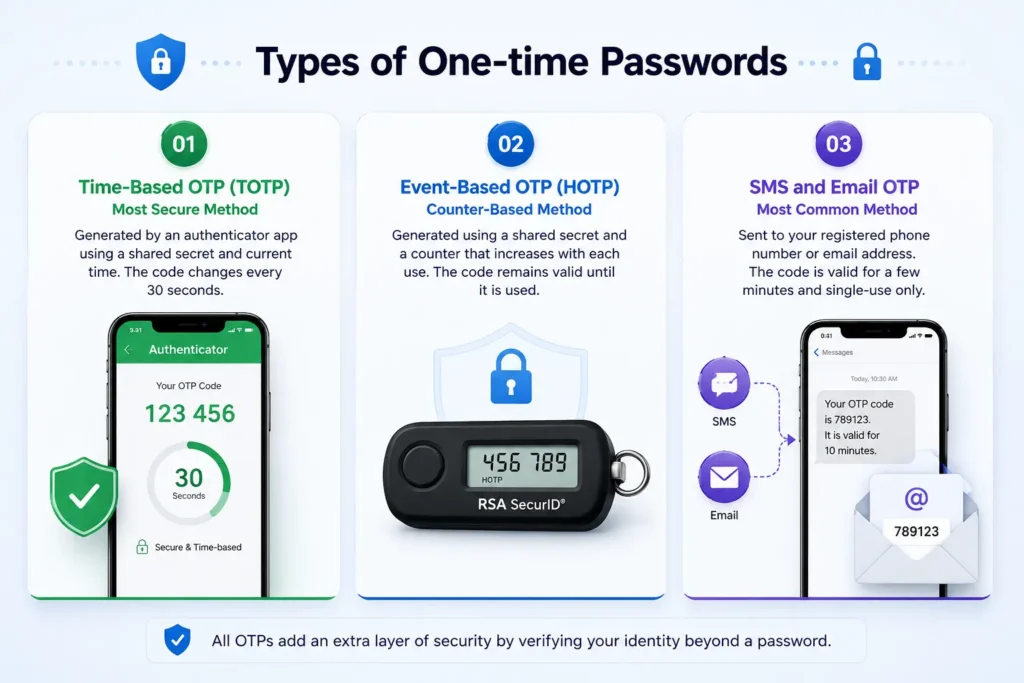
Time-based OTP is generated by an authenticator app and a server using a shared secret key. Both create the same 6-digit code based on the current time (every 30 seconds). The code is created on your device and not sent over any network until you enter it.
It expires in a short time, which makes it harder for attackers to steal or reuse. This method is used by Google, GitHub, and similar platforms because it’s safer than SMS and can’t be intercepted during transmission.
Google’s research shows that two-factor authentication (such as OTPs) can block 99.9% of automated account-hacking attempts. TOTP-based OTPs are even safer because they don’t travel over a network, which reduces the risk of interception.
HOTP (HMAC-Based One-Time Password) generates codes using a shared secret and a counter that increases each time a new code is created. There is no time limit, and the code stays valid until it is used.
Both the server and device must stay in sync using the same counter value. If they fall out of sync, login can fail. These methods are common in hardware tokens and banking devices like RSA SecurID.
SMS and Email OTPs are sent to the registered phone number or email after a login or a transaction attempt. In this method, you enter the received code to verify your identity. Codes are valid for 5–10 minutes and can be used only once.
SMS and email OTP are widely used in banking, shopping, and social media due to their ease of access. However, they are less secure and can be exposed to SIM swap or email compromise attacks.
The cybersecurity industry has evolved in the past few years, and in such cases, passwords are not enough to stay safe. Every 39 seconds, a hacker attempts to break into an account, and 81% of data breaches involve stolen credentials. One expiring code – OTPs can change that equation entirely.
In 2026, OTPs add extra security beyond passwords. They are essential for combating AI-driven social engineering and securing sensitive financial, healthcare, and government transactions.
Here are the reasons why OTPs can’t be ignored in 2026 for account security:
OTPs are used in every digital interaction: online banking, e-commerce, healthcare websites, corporate VPNs, crypto exchanges, and the apps on your phone.
A one-time password is an effective security tool for the cybersecurity industry. For daily accounts, SMS OTP is a better option, while TOTP is good for important accounts like email, banking apps, and work systems. For highly sensitive accounts, a hardware security key will provide the strongest protection.
Bots made up 80% of all fraud attempts, and an OTP expires before it can be used. In a world where $1 trillion was lost to fraud in 12 months, a one-time password is not optional. The few seconds it takes for an OTP to verify your identity could be the difference between a secure account and a compromised one.
What does OTP mean?
OTP refers to One-Time Password, which is a temporary, auto-generated code used to verify identity during login or a transaction. It is valid for only one use or a short time window to make it more secure than a static password alone.
What is email OTP in marketing?
In marketing, email OTP is a one-time password sent to a user’s email to verify their identity during signup, login, or transactions, helping brands confirm real users and reduce fake accounts.
How long is an OTP valid?
It depends on the type of OTP. A TOTP code (from authenticator apps) is valid for 30–60 seconds, while SMS and email OTPs are valid for 5–10 minutes or until used once.
Can an OTP be hacked?
Once the single OTP code is used or expires, it can’t be used again due to its time expiration. Hackers can sometimes trick users in real time to steal OTPs before they expire, using fake conversations or a scam. SIM swap attacks can also intercept SMS OTPs; that’s why app-based TOTP is much safer against these risks.
Why do OTPs expire so quickly?
The short expiry period is the core security feature of an OTP. A 30-second TOTP or single-use SMS OTP ensures that even if a code is intercepted in transit, it becomes worthless instantly to give attackers no practical window to exploit it.
HOTP vs TOTP: Which is more secure?
HOTP is a counter-based OTP that stays valid until it is used, while TOTP is a time-based OTP that expires quickly in 30–120 seconds. Both are used for login security, but TOTP is more secure because its short expiry reduces the chance of reuse or interception compared to HOTP.
Email OTP vs. SMS OTP: Which is better for lead authentication in 2026?
Email OTP is better for lead authentication because it is more secure, cost-effective, and harder to intercept than SMS OTP. Although SMS OTP is faster and more convenient for mobile users, it’s more vulnerable to SIM swap and network attacks. In 2026, many businesses prefer email OTPs for safe, reliable lead verification, while SMS OTPs are used for instant mobile verification.
What is the difference between OTP and 2FA?
OTP is not the same as 2FA, but it is part of a two-factor authentication (2FA) security system that demands two separate proofs of your identity before granting access. Think of 2FA as the lock and an OTP as one of the keys that open it. Other keys include biometrics, hardware tokens, and push notifications, but OTP is widely used because it only requires your phone number/email or an app.